
How much and when to irrigate, seven days out.
We maximise irrigation efficiency by preventing crop water stress, while reducing losses from evaporation, drainage, fertiliser leaching and irrigation system maintenance costs.
Better scheduling can lead to:
- Increased yields
- Less water usage
- Reduced electricity costs
- Reduced irrigation system maintenance costs
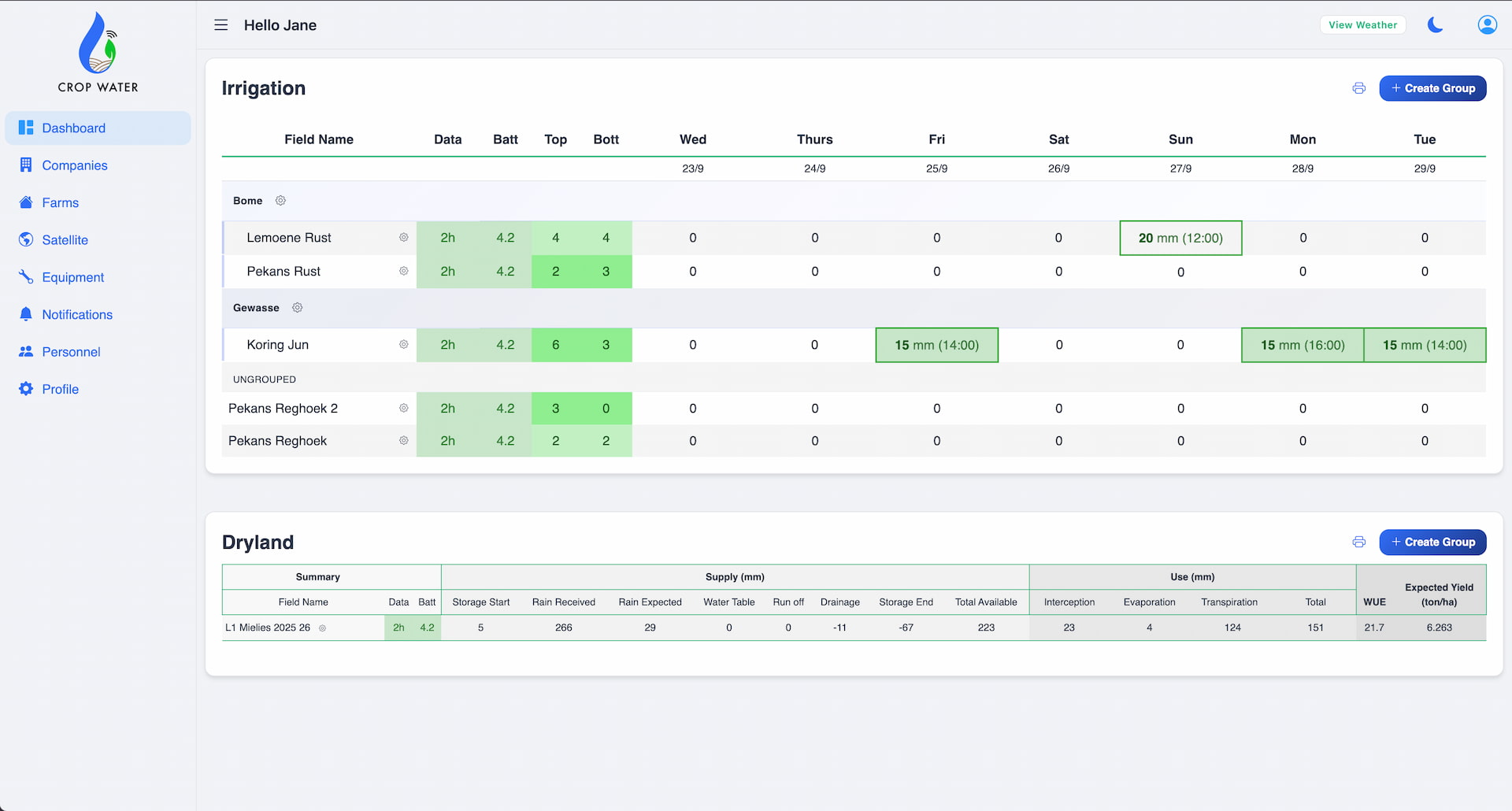
Here is how the system works to optimise your scheduling:
- Continuous integration and simulations: The platform calculates your current soil water deficit and forecasts when and how much to irrigate.
- Hourly data: Hourly data from calibrated soil moisture probes, real-time weather stations and localised weather forecasts.
- Tailored parameters: The calculations are fully customised to the soil and crop parameters of your field.
- Expert verification: To ensure precision, experienced consultants cross-check the calculations and recommendations.
- Clear outputs: The recommended irrigations for the next seven days show the day and the best time of day.
- Continuous advice: You can share the data with any of your advisors, for advice on how to apply it in your decisions.
Three decades of irrigation scheduling.
Practical, field-tested experience behind every recommendation.
Know your expected yield for planning, long before planting
Crop Water’s dryland water management tool continuously quantifies the water you can expect for the current or coming season. This lets you make better financial decisions.
Make better financial decisions
We help you make the important decisions when it comes to budgeting for the season ahead.
Water limited season
Rain is expected to fall short.
- YieldWater stress limits yields, reduce inputs
- Plant PopulationLower plant populations or skip the season
- FertiliserSkip or limit the fertiliser, use it where it will make a difference
- PesticidesLeave the bugs in peace, use the pesticides later
Favourable rainfall season
Good rain is expected.
- YieldMore water, increased yield, increased inputs
- Plant PopulationHigher populations for higher yield potential
- FertiliserIncreased rates for higher yield potential
- PesticidesMore to eat for the bugs, make sure they don’t chow the profits
Advanced insights for smarter planning
Your data journey begins long before planting. Historical measurements, predictive models and simulations shape your pre-season strategy. As the season unfolds, real-time data refines these insights. This reduces uncertainty, so you can make accurate, confident decisions.

Here is how the system works to optimise your dryland decisions:
- Continuous integration and simulations: The platform calculates the water currently available in your soil profile.
- Hourly data: Hourly data from calibrated soil moisture probes, real-time weather stations and localised weather forecasts.
- Tailored parameters: The calculations are fully customised to the soil and crop parameters of your field.
- Expert verification: To ensure precision, experienced consultants cross-check the calculations.
- Clear outputs: The water budget summary and its components update continuously.
- Continuous advice: You can share the data with any of your advisors, for advice on how to apply it in your decisions.
From data your farm is already producing.
1
Draw your fields
Freehand polygons or circles on a satellite map, with the area calculated in hectares automatically.
2
Connect your devices
Assign a soil moisture probe and a weather station to each field.
3
Configure crop and soil
A guided four-step wizard: general, crop, calibration and soil, with a managed soil type and crop library.
4
Open the dashboard
Every field in one table, with today’s schedule and the season outlook.
We make our own equipment.
Soil moisture probes, weather stations and rain gauges, to rent or to buy.